



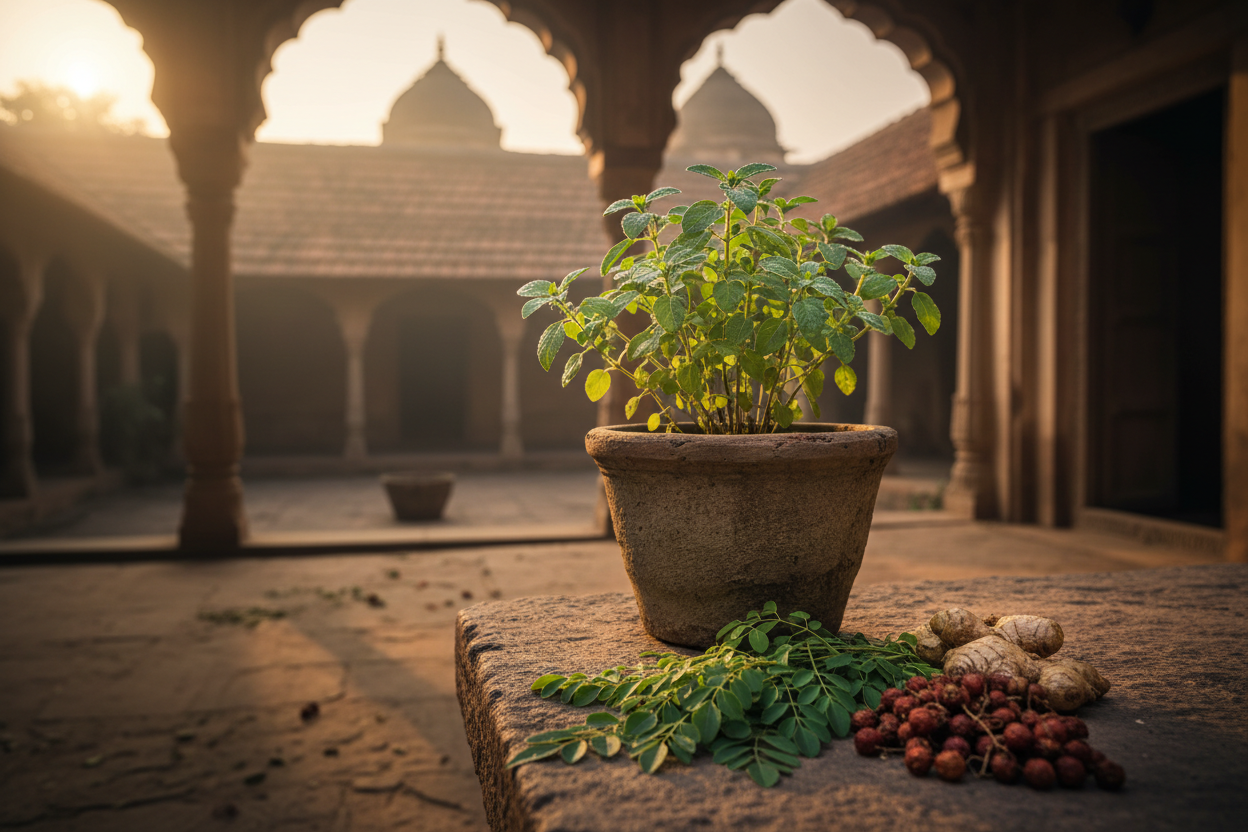
Before moringa became a superfood, it was just the tree in the backyard.
Every house in South India seemed to have one — tall, unassuming, its feathery leaves catching the morning light. Nobody called it a superfood. Nobody talked about its protein content or its antioxidant profile. The aunties just knew to add the drumstick to the sambar, to dry the leaves and mix them into rice, to give the children a little extra during exam season because it "gives strength." That was enough. That was everything.
There is something quietly heartbreaking about watching the ingredients of our childhood become the discoveries of someone else's wellness industry.
Tulsi grew in every courtyard. Not as a health supplement — as a sacred presence. The plant that was watered every morning, that the elders circled with a diya at dusk, that the grandmother plucked from when a child had a cold. A few leaves in hot water with ginger and honey. No measuring spoons. No timers. Just instinct, and love, and the knowledge that this had worked for a hundred years before you were born.
Ginger — adrak — was never exotic. It was the first thing added to the chai, the thing grated into the kadha when the rains brought fever, the ingredient that appeared in every kitchen without fanfare. It didn't need a label that said "anti-inflammatory." It just worked, and everyone knew it worked, and that was the end of the conversation.
Triphala sat in the medicine cabinet of every Ayurvedic household — three fruits, combined in a ratio that ancient practitioners had refined over centuries. It was taken quietly, without drama, before bed. Not because someone read about it online. Because a grandmother gave it to a mother, who gave it to a daughter, who would one day give it to her own children.
This is how knowledge survived. Not through papers or patents. Through spoons and stories.
I think about my mother's kitchen in the way some people think about temples. There was a reverence to it — a sense that what happened there mattered. The grinding stone that sat in the corner, worn smooth from decades of use. The small steel containers lined up by the stove, each one holding something that served a purpose beyond flavour. The smell of mustard seeds hitting hot oil, of curry leaves releasing their fragrance, of something slow-cooking that would be ready by the time everyone came home.
Nothing in that kitchen was accidental. Every ingredient had a reason. Every combination had a logic — not the logic of a laboratory, but the logic of lived experience, refined across generations.
Ayurveda understood something that modern nutrition science is still catching up to: that food is not just fuel. It is medicine. It is memory. It is the invisible thread that connects us to the people who came before us and the land they lived on.
When you eat moringa, you are eating what your great-grandmother ate. When you drink tulsi tea, you are participating in a ritual that predates every wellness brand by thousands of years. When you reach for triphala, you are trusting a formulation that has been tested not in a lab, but in the lives of millions of people across centuries.
That is not a small thing. That is an extraordinary thing.
The tragedy is not that these ingredients disappeared. They didn't. They were always there — in the markets, in the gardens, in the old recipes that nobody had time to make anymore. The tragedy is that we stopped seeing them. We walked past the moringa tree without looking up. We bought packaged ginger powder instead of the fresh root. We forgot that the tulsi plant on the balcony was not decoration — it was medicine, waiting to be used.
Somewhere along the way, we began to trust the unfamiliar more than the known. We reached for supplements with names we couldn't pronounce while the ingredients our grandmothers swore by gathered dust in the back of the pantry.
There is a quiet revolution happening now — not in laboratories, but in kitchens. People are returning to the ingredients of their childhoods, not out of nostalgia alone, but out of a growing recognition that the old ways held a wisdom we were too quick to discard.
They are asking the questions their grandmothers never had to ask: What is in this? Where does it come from? Does it actually work?
The answers, more often than not, lead back to the same place. Back to the backyard moringa tree. Back to the courtyard tulsi plant. Back to the brass dabba on the highest shelf.
Back to a spoonful of tradition.
Sendriya Life was built on the belief that India's botanical heritage is not a relic — it is a resource. Every ingredient we source carries the weight of that history, and the responsibility of honouring it.


