



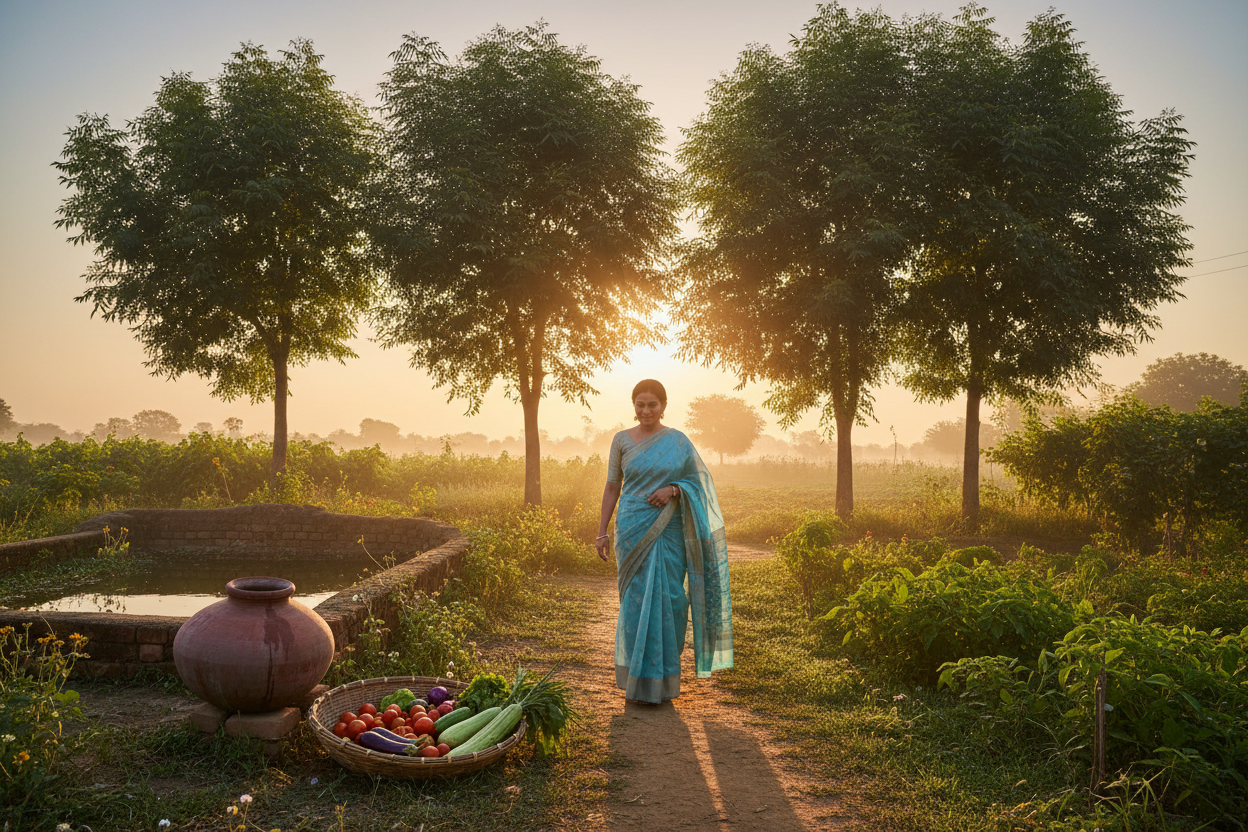
Nobody in my grandfather's village talked about wellness.
They talked about the harvest. About the rains coming late. About whose daughter was getting married and whether the mango crop would be good this year. They talked about everything except their health — because their health, for the most part, was not something they had to think about. It was something they lived.
They woke with the sun and slept when it set. They ate what the season offered and rested when the body asked for it. They walked everywhere, worked with their hands, and gathered in the evenings under the neem tree to talk and laugh and simply be together. Wellness was not a practice they had to carve time for. It was the shape of their days.
I think about this often — about how much we have gained, and what we have quietly lost.
There is a particular quality to early mornings in Indian villages that I have never been able to find anywhere else. The air before sunrise carries something — a stillness, a coolness, a faint smell of earth and smoke and something green. The cows are already awake. The birds are already loud. And somewhere, in every home, someone is already in the kitchen.
My grandmother was always the first one up. By the time I stumbled out of bed, she had already swept the courtyard, watered the tulsi, and set the milk to boil. She moved through these tasks not as chores, but as a kind of morning prayer — each action deliberate, unhurried, connected to something larger than itself.
She never called it a morning routine. She never called it self-care. She just called it subah — morning. And morning, in her world, was sacred.
The food in that house was medicine, though nobody used that word. The dal was always tempered with hing and jeera — not just for taste, but because it helped the stomach. The rice was sometimes cooked with a few peppercorns. The seasonal vegetables were chosen not just for what was available, but for what the body needed in that particular month. In summer, cooling foods. In winter, warming ones. In the monsoon, lighter meals that didn't burden the digestion.
This was Ayurveda — not as a system to be studied, but as a way of seeing. A way of understanding that the body is not separate from the world it lives in, that what we eat and how we live must change as the seasons change, that health is not a destination but a daily conversation between the self and the world.
Nobody had to teach my grandmother this. She had absorbed it the way she had absorbed everything — through watching, through doing, through the slow accumulation of a life lived close to the earth.
I am not romanticising poverty or hardship. Life in those villages was difficult in ways that are easy to forget when you are only visiting. But there was something in the rhythm of that life — in its rootedness, its seasonality, its deep connection to the natural world — that we have not found a replacement for.
We have replaced the morning walk with the gym. The seasonal vegetable with the year-round supermarket. The evening gathering under the neem tree with the blue light of screens. We have replaced slowness with efficiency, and in doing so, we have lost something that efficiency cannot give back.
We have lost the feeling of being well without trying.
The wellness industry is worth billions now. There are apps for sleep, subscriptions for supplements, retreats for rest. We have more tools for health than any generation before us — and yet anxiety, fatigue, and disconnection have never been more common. We are optimising everything except the thing that actually matters: the quality of our daily life.
What my grandfather's village had was not a wellness programme. It was a culture. A set of values and habits and relationships that made health the natural outcome of simply living well. Community. Rhythm. Seasonality. Simplicity. The understanding that the body is not a machine to be managed, but a living thing to be tended.
We cannot go back. Nor should we try to. But we can remember. We can carry forward the parts of that wisdom that still apply — the early morning, the seasonal eating, the herbs that have always worked, the understanding that rest is not laziness but necessity. We can choose, in small ways, to slow down. To pay attention. To treat the daily act of nourishment as something worthy of care.
Wellness was never meant to be a trend. It was always meant to be a way of life.
Our grandparents knew this. Their grandparents knew this. And somewhere, beneath the noise of modern living, we know it too.
We just need to remember.
Sendriya Life exists to help you remember. Our products are rooted in India's living traditions — made with ingredients that have always been part of this land, offered with the respect they deserve.


