



Think about the last time you were in your grandmother's kitchen.
Not to visit. Just to stand there for a moment. The smell of something on the stove. The small jars arranged near the window. The brass container she always kept close to the gas — the one she opened without thinking, adding a pinch of this, a piece of that, because she just knew.
She didn't read the label. She didn't check the nutritional information.
She knew what it was because she had always known what it was.
That knowing — quiet, confident, everyday — is what we are trying to put into a tin.
How Indian kitchens worked
For a very long time, the Indian kitchen was its own kind of pharmacy.
Not in a dramatic way. Not with complicated protocols. Just with the understanding that certain things — certain roots, leaves, spices, herbs — were good for you in everyday amounts, used in everyday ways.
Ginger went into the chai not just for taste. Turmeric went into the dal not just for colour. The warm milk before bed had something stirred into it not just out of habit. These were choices made across generations. Small, daily, quiet choices that added up to something.
Nobody called it wellness. It was just cooking.
What happened to that knowledge
It did not disappear overnight.
It faded. Slowly. As kitchens got faster and busier, the things that took time started getting left out. As packaged food became normal, the habit of using raw, whole ingredients became less common. As families moved to cities, the connection to where food came from — and how it had always been used — started to break.
And then, a strange thing happened.
The same ingredients that had quietly left Indian kitchens started showing up in health stores. In capsules. In expensive powders with English names that most Indian grandmothers would not recognise on a label — even though they had used that exact thing their entire lives.
The words were new. The ingredient was old. And somewhere in the translation, the original story got lost.
We wanted to tell the original story
Not the version where a root becomes a supplement.
The version where your grandmother kept it in a small container near the stove and used it without thinking twice.
Every product we make starts from that version. We ask: how was this ingredient used before anyone tried to sell it? What form was it in? How did people actually encounter it in daily life?
And then we try to make a product that is as close to that form as possible.
Not because we are being precious about tradition. Because that form worked. It worked for a very long time, in a very large number of households, without anyone needing to be convinced of it.
One ingredient. The whole story.
Each tin we make contains one ingredient.
Not because we couldn't add more. Because when you add more, the story of each ingredient gets buried under the story of the blend. And each ingredient deserves its own story.
When you open one of our tins, you are opening the story of one thing. Where it came from. How it has been used. What it means in Indian cooking and Indian homes.
That story has been the same for centuries. We are just trying to make sure it does not get rewritten.
Why we put it in a tin
We chose the tin because it protects.
It keeps out light and air. It keeps the ingredient exactly as it was when it went in. It is not decorative. It is functional.
But we also chose it because of what a tin represents.
Your grandmother had tins. Small metal containers for things she used every day — spices, grains, powders. They were not fancy. They were practical. They sat near the stove and got opened without ceremony.
That is how we want our products to live in your kitchen. Not on display. Not saved for a special occasion. Just near the stove, getting opened without ceremony, doing what they have always done.
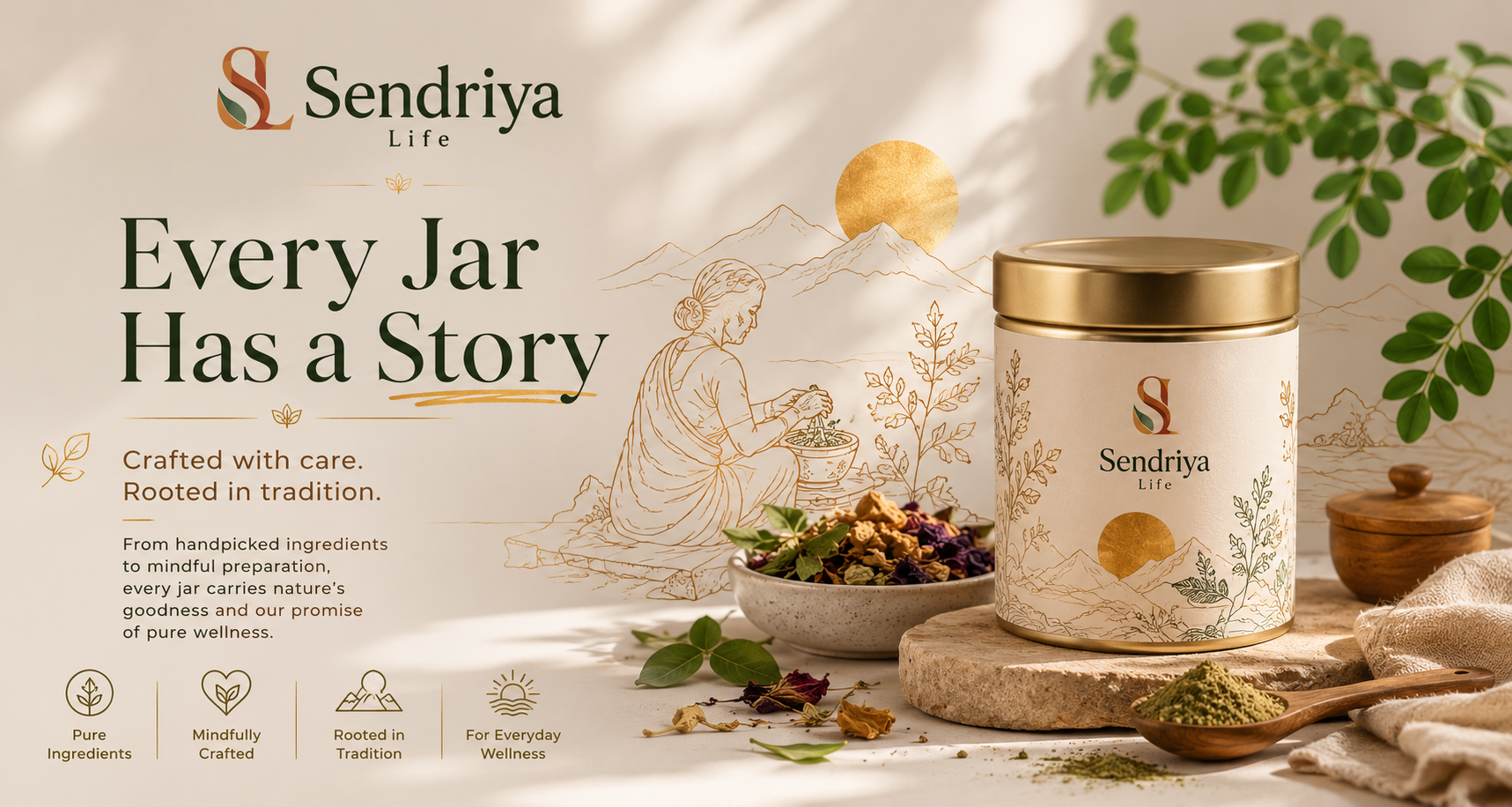
Every jar has a story. This is ours.


